


The disaster had unfolded as he became engrossed in an affair with the woman who had treated him, Dr. Sabine Falkner, a German-Russian working for the Russian government. She had taken him in after his family had refused to see him again. He was hurt, abandoned, confused, and reeling from the treatment. And she, marveling at his new abilities, his strength, his superhuman reflexes, willingly took the treatment herself. They became vampires together, ravaging, clutching, hammering at each other’s bodies at night with ferocious joy, gulping blood from ceramic cups, while the world around them plunged into total perdition, depredation, and darkness.
Sabine was thirty years his senior, older than Aleksej’s mother, and a respected member of the team which had taken the Human Vampirism Virus (HVV) and Lyssavirus rabies, disabled their dangerous aspects, and used them to identify which pathways went active or quiet in a patient’s brain during severely suicidal, narcopathic, or schizoid episodes. They then used psilocybin to reconnect those pathways to other neural lattices that oriented the individual out of fear, anxiety and repetitive traumatic ruminations. The patient’s brain slowly adjusted to focus on the outside world again. The results were astounding, even miraculous, especially for ex-soldiers, who said, over and over, “I felt like myself again.” “The world felt completely reborn, brand new.” “I wasn’t trapped in my head any longer.” And so on.
It seemed a magnificent triumph, as though mental illness could be healed once and for all, one brain cell at a time. The treatment did not just alter mood like the old SSRI drugs. As studies progressed, the doctors realized that they had found the back door to the connection between physicality and consciousness, because an induced shift in focus transformed the patient’s whole identity and fundamental existence. For the first time, researchers were able to grasp how that shift could occur first at the cellular level but then, miraculously, move from the realm of biology and physiology into relational physics. The brain did not just change. It changed in the direction of whatever field into which it was placed. It entered the patient into a new frame of being, where their mental illness simply ceased to exist.
Lexi, as one of the test subjects in the secret black box Russian genomics program, had witnessed the scientists’ exultation. To further this process, they used a gene editor to alter the zoonotic rabies virus and HVV. They produced a new virus, Human Nocturnal Neuroadaptive Virus (HNNV), with the goal of creating in infected patients a radical physiological, physical, and emotional resilience, with reduced fear responses and trauma loads.

This treatment was hailed as a global victory over the trials and miseries of the human condition, although it provoked widespread skepticism. It would bring world peace! Finally, economies would stabilize! At last, humans would behave rationally! Critics wrung their hands and clutched their pearls. A long-forgotten moment when he was a celebrity guest on a television show flashed through Lexi’s mind as a nay-sayer pressed him: “Pain is what makes us human – can’t you see that?” The host of the show quipped: “Maybe – if you’re Russian.” And everyone laughed.

Progress won in the pre-extinction world and Russia claimed the honors of launching a global treatment for mental illness. In an unexpected turn of events, Russia took the credit for stabilizing geopolitics. A world war was averted. Just over one billion, perhaps 15 per cent of the global population, lined up to be voluntarily infected with HNNV.
The treatment gained cachet because of its whispered vampiric origins. It became trendy and cool, even after it emerged that the infected were becoming rather vampire-like in their proclivities and abilities. Vampires don’t get scared. They don’t get tired. They are wealthy. They don’t make mistakes. They are mysterious. They are strong and ultra smart. They are superpeople. Accept your superhumanity. Allow it to pulse through you. Slowly, the old vampires who were infected with HVV exited the shadows and joined a huge public debate about their rights and predatory natures, compared to the behaviors of HNNV carriers who were simply recipients of a medical treatment.
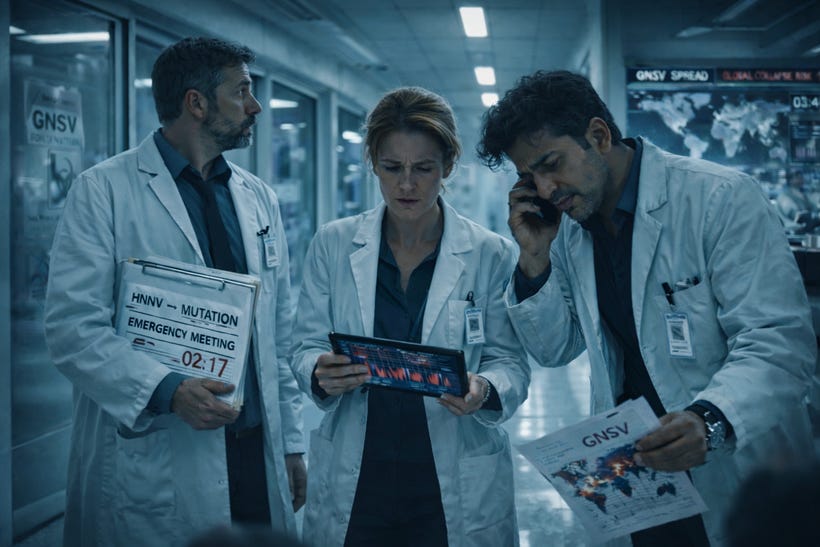
Then unexpectedly, after the first cycle of mass HNNV treatments, a third, mutated virus emerged, Global Neurodegenerative Syndrome Virus (GNSV), which acted chaotically as a collapse vector. Only much later did vampire scientists begin to understand that GNSV had done more than attack baseline human immune systems. It was existential: a cascading collapse of the time and space where humans could meaningfully exist. As HVV had altered the body, and HNNV had changed perception, GNSV changed existence. Vampires were immune to GNSV, but humans were wholly affected. Homo sapiens did not die burning with fever, screaming, vomiting, and hemorrhaging. As with honeybees in Colony Collapse Disorder, they simply began to lose their relational anchoring to reality, mysteriously drifting into a strange, terrifying, mass extinction, which the vampires, old or new, were helpless to prevent.
It took time for the vampires to understand that immunity was not a gadget one could take apart and rebuild. Either way, over hundreds of years, most of the old vampires infected with HVV accepted HNNV treatments to stabilize their systems, reduce their predatory impulses, and enable them to consume artificial blood to stay alive. There were some holdouts, but the new vampire militias hunted them down. And with that, Homo sapiens vampiris proceeded to do what Homo sapiens had never really managed to do: depart for the stars.
-- To Be Continued ...
© 2026 Larissa Douglass. All rights reserved.
No part of this work may be reproduced, distributed, or transmitted in any form or by any means without prior written permission of the author.
This excerpt was originally published on Patreon on 19 February 2026.